
A supplement label design brief gives a creative team the information needed to make the packaging distinctive without losing accuracy. It connects brand ambition with product facts, required statements, production constraints, and the customer’s first impression on the shelf or screen.

Begin with the product truth
List the product name, category, format, serving information, quantity, ingredients, directions, warnings, manufacturer details, batch or expiry areas, and any required facts. The design process becomes safer when the source information is complete and clearly versioned.
Separate confirmed facts from proposed marketing language. A designer can create hierarchy and visual appeal, but the product owner remains responsible for validating the information that appears on the label.
Define the brand and audience
Explain who the product is for, how it should feel, and where it will be sold. Premium, clinical, natural, energetic, minimalist, and approachable directions can lead to very different choices in colour, typography, imagery, and finish.
Share references you like and explain why you like them. A reference should guide mood and quality, not encourage copying another brand’s identity.
- Supply verified product facts
- Define audience, positioning, and visual direction
- Separate approved claims from ideas
- Share accurate dimensions and production details
- Agree on review rounds and final file formats

Clarify claims and constraints
Provide the approved claims, certifications, symbols, disclaimers, and wording that must or must not appear. Flag the markets and channels where the product will be sold so the review process considers the right requirements.
Avoid asking design to rescue uncertain claims at the last minute. Early clarity reduces revisions and helps the layout reserve space for mandatory information.
Plan the physical label
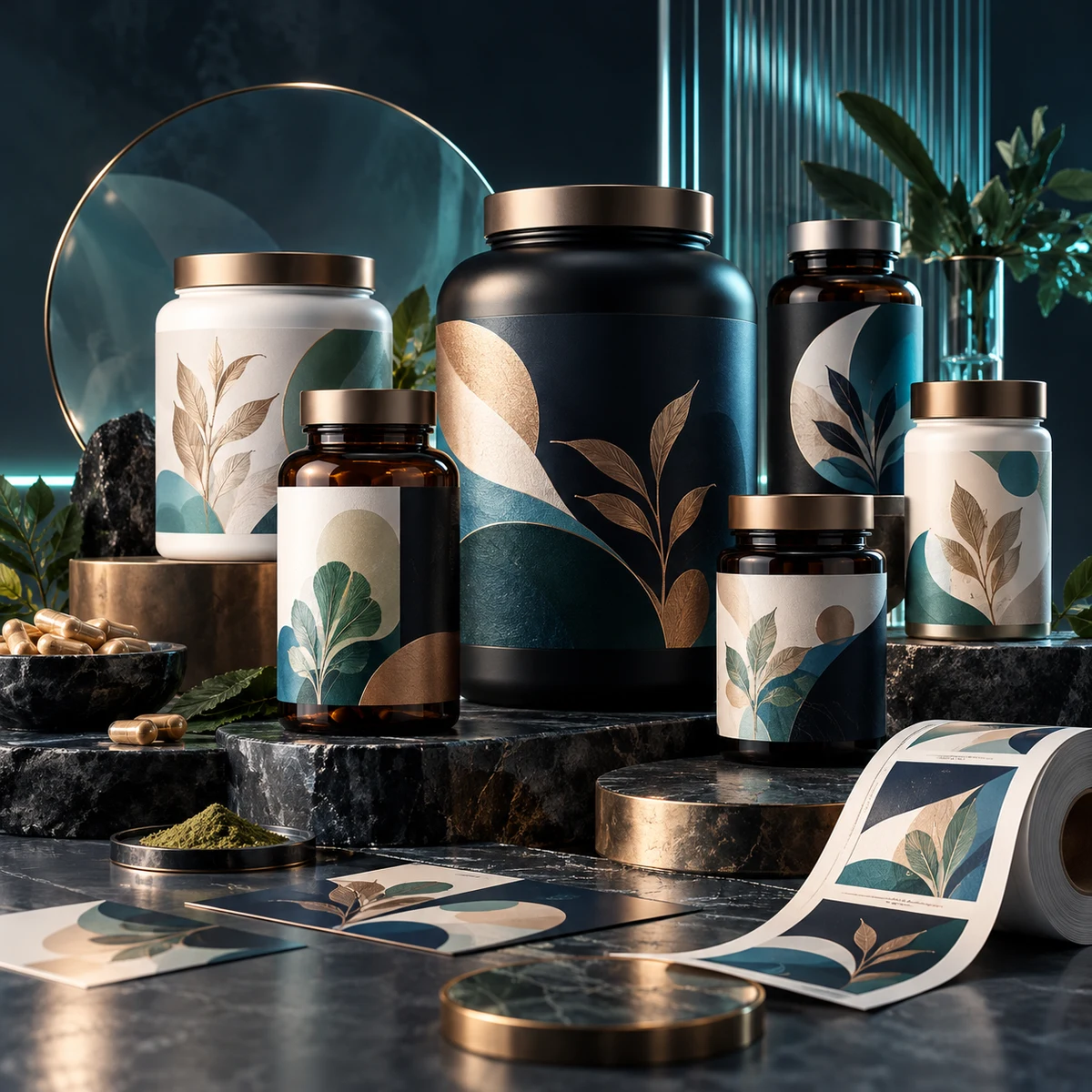
Give the exact container, label dimensions, wrap direction, bleed, safe area, print method, material, finish, colour requirements, and any transparent, metallic, embossed, or foil treatments. A beautiful screen mockup still needs to work on the actual package.
If the label wraps around a bottle, identify front, back, side, seam, and curvature. Use a dieline or production template whenever possible.
Define approval and final files
Name the decision-maker, provide the review deadline, and explain what counts as an approved round. Ask for realistic mockups as well as print-ready artwork so the team can judge both shelf presence and production detail.
Agree on final formats, colour mode, linked or outlined fonts, image resolution, bleed, and editable source files. A clear handoff protects the investment after the design is approved.
Frequently asked questions
What makes a supplement label brief effective?
It is complete, organized, and honest about what is confirmed. It gives the designer enough context to make decisions while clearly identifying content that still needs approval.
Should the designer handle compliance?
A designer can organize required information and flag obvious layout concerns, but product owners and qualified reviewers should verify regulatory and market-specific requirements.
How early should packaging dimensions be provided?
Before the main design begins. Dimensions, curvature, seams, finishes, and print limitations directly affect hierarchy and artwork preparation.
Ready to turn the next improvement into a measurable result? Explore AETRIXA’s web design and development service and build a practical plan around your goals, customers, and available resources.
A practical supplement label design brief action plan
The best results from supplement label design brief come from improving the complete customer and team experience, not only one screen or feature. A reliable process makes the important action clearer, removes avoidable uncertainty, and gives the business a way to learn from real use after launch.
Define the moment you want to improve
Write down what the customer is trying to accomplish, what the team needs to know, and where confusion or delay currently appears. This turns a broad request into a journey that can be reviewed, tested, and measured. It also helps prevent a solution from becoming more complicated than the problem.
For this project, prioritize these actions: Separate verified product facts from proposed marketing language; Define audience, positioning, claims, and market requirements; Provide accurate dimensions, finishes, dielines, and final-file expectations. Keep the first version focused, then add complexity only when customer evidence or operational needs justify it.
Watch for the expensive shortcut
One of the most common mistakes is starting visual exploration before content, packaging constraints, and approval responsibilities are clear. The shortcut may feel fast during planning, but it often moves the cost into support, manual administration, failed transactions, rework, or customer hesitation. Clear requirements are usually faster than repairing an unclear implementation later.
Use a practical quality gate
Check a version-controlled brief with approved facts, production details, decision-makers, review rounds, and a reliable final handoff. Ask someone unfamiliar with the internal process to complete the journey from start to finish. Note every question they ask, every step they hesitate over, and every detail they expect but cannot find. Those observations create a useful next-round backlog.
- Is the next action obvious?
- Are important costs, requirements, and expectations visible?
- Does the experience work for different devices and abilities?
- Can the team monitor and maintain it after launch?
Further reading and next steps
For a deeper reference, review the FDA’s dietary supplement resources. Then choose one customer-facing improvement and one operational improvement to test this month. That is how supplement label design brief becomes a durable advantage rather than a one-time project.